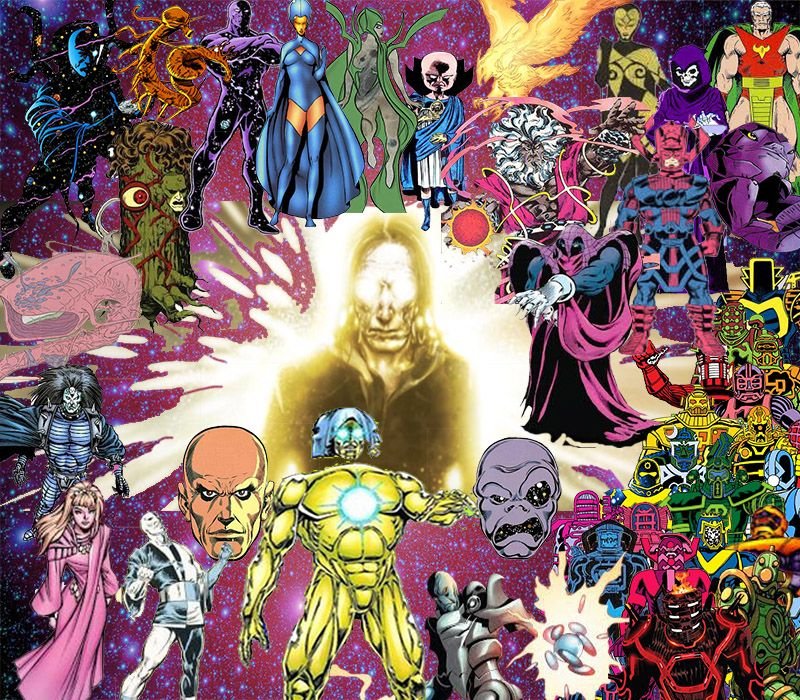
When you dive into the Marvel Comics Universe, few entities loom as large, or as intimidatingly, as Galactus, the Devourer of Worlds. He's an icon of cosmic dread, a force of nature whose hunger dictates the fate of countless civilizations. But in a universe teeming with god-like beings, where exactly does Galactus stand? Is he at the absolute pinnacle, or are there powers even he must bow to? This article is your definitive guide to comparing Galactus's scale to other Marvel Cosmic Entities, exploring the vast, intricate hierarchy of power that defines the very fabric of reality.
Galactus is a massive threat, no doubt, but the Marvel Multiverse is vast, filled with beings who operate on entirely different levels of existence. Understanding this hierarchy isn't just a fun exercise in power-scaling; it illuminates the stakes of virtually every major cosmic storyline, from the Infinity Gauntlet to Secret Wars.
At a Glance: Understanding the Cosmic Power Ladder
- Galactus is a Planetary Threat: He's an omega-level cosmic entity who devours planets for sustenance, capable of wielding immense cosmic energy.
- Not the Apex: While incredibly powerful, Galactus is far from the most powerful being in the Marvel Multiverse.
- Hierarchy is Layered: Cosmic entities exist in distinct tiers, from universal abstractions to multiversal enforcers, and ultimately, absolute omnipotence.
- Purpose Defines Power: Many entities embody fundamental aspects of existence (time, space, death), giving them power over those concepts.
- Scale Varies: "Scale" isn't just raw power; it also involves scope of influence (universal vs. multiversal) and the entity's role in the cosmic order.
Galactus: The Devourer's Cosmic Pedigree
Let's start with the big guy himself. Galactus, born Galan of Taa, is a sole survivor of the previous universe, transformed by the Sentience of the Universe into a being of immense cosmic power, destined to consume worlds. His primary drive is hunger, a constant, gnawing need for planetary energy to maintain his existence and prevent the universe from falling out of balance. His power is almost unfathomable to mortals, allowing him to manipulate matter and energy on a galactic scale, bestow power upon his Heralds, and withstand attacks that would shatter planets.
He is a force of nature, an essential component of the cosmic order, tasked with balancing life and death, creation and destruction. While his existence means destruction for many worlds, it also paradoxically allows for new life to flourish. His sheer physical presence is staggering, often depicted as hundreds or even thousands of feet tall, making a moon look like a pebble. For a deeper dive into his physical and energy scale, you might be interested in Understanding Galactus size.
Despite his incredible might, Galactus is still bound by certain cosmic laws and sometimes experiences defeats, even at the hands of Earth's mightiest heroes when sufficiently motivated and organized. This vulnerability hints at the greater powers that exist above him.
The Apex of Omnipotence: Beyond Comprehension
When we talk about true cosmic supremacy, we're talking about beings whose power is so absolute that Galactus is, by comparison, a mere whisper in the cosmic winds.
The One Above All (TOAA): The Ultimate Creator
At the absolute zenith of the Marvel cosmic scale sits The One Above All (TOAA). Imagine the ultimate creator, the absolute authority, the literal author of all reality—that's TOAA. This entity is considered omnipotent, omniscient, and omnipresent, representing the ultimate source of all existence within the Marvel Multiverse. TOAA seldom makes direct appearances, often preferring to act through subtle guidance or inspiration, as famously seen in Fantastic Four (Vol. 3) #60 (2002).
Comparing Galactus to TOAA is like comparing a fictional character to their actual writer. There's no contest; TOAA is beyond the concept of power-scaling, existing on a plane so far removed that even the most powerful cosmic entities are ultimately its creations or reflections.
The Beyonder (Original Incarnation) and the Beyonders
The Beyonder, in his initial portrayal from Secret Wars #1 (1984), was a being from outside the Marvel Multiverse, depicted as nearly omnipotent. His power was so vast he could manipulate reality on a multiversal scale, creating and destroying entire universes with a whim. He pulled heroes and villains from across the cosmos to battle in his "Battleworld," simply out of curiosity.
This original Beyonder was, for a time, considered superior to virtually all other cosmic entities, including Galactus, the Living Tribunal, and even Eternity. Later retcons, particularly in New Avengers #29-34 (2014), redefined the Beyonder as a member of a race called the Beyonders, cosmic beings from outside the multiverse who were responsible for the incursions leading to the 2015 Secret Wars. While still immensely powerful, this redefinition contextualized their power within a race, rather than a single, truly omnipotent individual. Even so, any iteration of the Beyonder or the Beyonders has historically operated on a scale far beyond Galactus's capacity.
The Architects of Reality and Balance
Beneath the absolute omnipotence, but still far above Galactus, are the entities responsible for maintaining the fundamental laws and balance of the multiverse itself.
The Living Tribunal: Multiversal Justice
The Living Tribunal, introduced in Strange Tales #157 (1967), is the ultimate enforcer of cosmic justice and balance across the entire multiverse. This three-faced entity, each face representing a different aspect (Equity, Vengeance, Necessity), can alter reality with a single verdict, ensuring no single cosmic power or force upsets the equilibrium of existence. Its power is multiversal, meaning it can judge and intervene across countless realities simultaneously.
Galactus, for all his power, is a universal entity; he exists within a single universe (though his counterparts exist in others). The Living Tribunal oversees all of them. It has the authority and power to incapacitate or even erase beings like Galactus if their actions fundamentally threatened the multiversal balance. In cosmic terms, the Living Tribunal is a judge, jury, and executioner whose jurisdiction far exceeds Galactus's operational scope.
The In-Betweener: Personified Duality
Created by Jim Starlin and Ron Lim, the In-Betweener, first appearing in Warlock #9 (1975), personifies the duality of existence: life/death, good/evil, order/chaos, truth/illusion. This entity ensures that these opposing forces remain in a necessary flux, preventing one from completely dominating the other. While perhaps not as overtly powerful as the Living Tribunal in terms of raw intervention, the In-Betweener represents a fundamental cosmic truth that Galactus, as an entity of both destruction and preservation, inherently serves.
The In-Betweener operates at a conceptual level of reality, ensuring that the very fabric of existence doesn't become too monolithic. Galactus, while a powerful force, is still a concrete being within the universe, whereas the In-Betweener is the abstract principle that allows Galactus's very function (balancing life and death) to exist.
Eternity and Infinity: Time and Space Embodied
Eternity (first appearance: Strange Tales #138, 1965) and Infinity (first appearance: Quasar #24, 1991) are the living personifications of time and space themselves, respectively. These two cosmic abstracts embody the entirety of the universe's temporal and spatial dimensions. Their power is inherent to their existence; they are time and space. They possess cosmic awareness of everything that happens within their domains.
Galactus, though ancient and tied to the universal life cycle, exists within time and space. Eternity and Infinity are time and space. This places them on a fundamentally higher conceptual plane. They are often depicted as benevolent, maintaining the universal balance, and have the power to manifest anywhere and manipulate their respective domains with effortless ease. Galactus would be a fleeting thought in their consciousness, a player on their grand stage.
The Fulcrum: The Enigmatic Abstraction
The Fulcrum is a highly enigmatic and abstract entity, whose role became clearer in Eternals (Vol. 4) #5 (January 2009). It's depicted as a being that represents the abstract space between creation and destruction, order and chaos, potentially even supervising the Celestials and the Watchers. Its influence extends into higher dimensions, and it has a unique relationship with the Celestials and Eternals, suggesting it's an even more fundamental force than many cosmic entities. If it indeed supervises the Celestials, who themselves are vastly superior to Galactus, then the Fulcrum operates on a scale that Galactus cannot even perceive, let alone challenge.
The Cosmic Pantheon: Forces of the Cosmos
This pantheon comprises entities that personify fundamental forces and concepts within the universe. While many of them have cosmic reach, their power often directly correlates to the concept they embody.
- Death: The literal embodiment of death, holding authority over life, death, and souls (Captain Marvel #28, 1973). She can claim any soul, even Galactus's, given the right circumstances or intervention. Thanos's devotion to her underscores her cosmic importance.
- Mistress Love & Master Hate: These entities represent the fundamental emotional poles of the universe. While they may not engage in direct cosmic battles with energy blasts, their influence on sentient beings and their capacity to manipulate emotions on a grand scale can have multiversal repercussions.
- Chaos & Order: These two abstract beings embody the unpredictable and structured nature of the universe. They manipulate probability and causality, constantly striving for balance in their eternal dance. Their interactions, like the other Abstracts, influence reality in ways that can be more subtle but ultimately more profound than Galactus's direct actions.
Galactus operates within the framework these entities represent. While he is a force of destruction (Death's domain) and plays a role in the cosmic balance (Chaos and Order), he does not embody these concepts as fully as these abstract entities do. He is a powerful participant in their grand cosmic game, not a peer in their conceptual power.
The Architects, Judges, and Experimenters: Celestials and Elders
These groups represent cosmic powers that are far more advanced and ancient than most universal civilizations, operating on scales that often dwarf Galactus's direct actions.
The Celestials: Cosmic Architects
The Celestials, created by Jack Kirby, first appeared in The Eternals #1 (July 1976). These colossal, enigmatic beings are cosmic architects, genetic engineers, and judges of planetary worthiness. They travel the cosmos, experimenting with life forms, seeding planets with genetic potential (like creating the Eternals and Deviants on Earth), and returning millennia later to judge the evolutionary merits of their creations.
Celestials like Arishem the Judge, Eson the Searcher, and Exitar the Executioner wield power capable of terraforming planets, creating or destroying solar systems, and withstanding attacks from even fully fed Galactus. In many encounters, a single Celestial can be a match for Galactus, and a full host of them often forces him to retreat. They are generally considered superior in raw power and cosmic influence, especially given their role in shaping entire galaxies. Their motives are inscrutable, placing them beyond simple good or evil, much like Galactus.
The Elders of the Universe: Obsessed Immortals
The Elders of the Universe are a group of ancient, incredibly powerful beings who are the last survivors of their respective races from early in the universe's history. Each Elder is driven by a singular, all-consuming obsession, which they pursue across the cosmos, often with disregard for lesser beings.
- The Collector: Obsessed with collecting unique artifacts and life forms (The Avengers #28, 1966).
- The Grandmaster: Obsessed with games of skill and chance (The Avengers #69, 1969).
- The Champion: Obsessed with physical combat (Marvel Two-In-One Annual #7, 1982).
- The Gardener: Obsessed with cultivating life and plants (The Avengers #174, 1978).
- The Runner: Obsessed with speed and exploration (The Defenders #143, 1985).
While individual Elders generally do not possess the raw destructive power of a fully fed Galactus, their accumulated knowledge, vast wealth, specialized abilities, and cosmic artifacts make them formidable. Many have tangled with Galactus in the past, often through manipulation or by using their unique powers to gain an advantage, but they typically acknowledge his greater destructive might. Their power comes from billions of years of existence and mastery over their specific obsessions, allowing them to contend with universal forces in their own unique ways.
The Earthly Echoes: Eternals and Their Cosmic Ties
Even races connected to the higher cosmic powers illustrate the intricate web of influence. The Eternals, an immortal race created by the Celestials, debuted in The Eternals #1 (1976) by Jack Kirby. Tasked with safeguarding Earth, they possess superhuman strength, energy manipulation, and immortality. Notable members like Ikaris, Sersi, and Thena possess incredible powers by human standards.
However, the Eternals are clearly a step down from the entities discussed above. While they guard against cosmic threats, they are very much a part of the universal fabric, and their power pales in comparison to their Celestial creators, let alone Galactus. Their existence highlights the tiered nature of cosmic power: entities like Galactus represent an existential threat that even the highly advanced Eternals struggle against, often requiring broader alliances or strategic ingenuity to overcome. They are a crucial piece in the cosmic puzzle, but nowhere near Galactus's scale.
Understanding the Cosmic Hierarchy's Fluidity
One crucial aspect of comparing cosmic entities in Marvel is recognizing that their "scale" isn't always static. The Marvel Universe is a dynamic narrative, and power levels can shift based on the writer, the storyline, and the entity's current state.
- Plot Device vs. Consistent Power: Sometimes, an entity's power is dictated by the needs of a particular story. A fully-fed Galactus is vastly more powerful than a starved one, for instance.
- Aspects and Avatars: Some entities, like Eternity, might manifest as an avatar with a fraction of their true power, or be temporarily weakened.
- Cosmic Artifacts: The presence of cosmic artifacts, like the Infinity Gauntlet, can temporarily elevate a character's power to levels that rival or even surpass some of the higher-tier cosmic beings. Thanos with the completed Infinity Gauntlet was able to defeat many of the abstract entities, demonstrating that while the entities are powerful, their power can be manipulated or overcome by sufficient external means.
- Retcons and Reinterpretations: As seen with the Beyonder, characters can be recontextualized or redefined, changing their place in the power hierarchy.
Therefore, while a general hierarchy exists, it's always best to consider the specific context of any given confrontation or depiction.
Frequently Asked Cosmic Questions
Is Galactus truly a villain?
Not in the traditional sense. Galactus is a force of nature, a necessary component of the cosmic balance. He doesn't act out of malice but out of an unceasing, existential hunger. His existence, though destructive, is crucial for the rebirth and renewal of the universe, preventing it from collapsing in on itself. He represents a kind of cosmic triage, destroying some to preserve the whole.
Can anyone beat Galactus?
Yes, many can. As discussed, the Living Tribunal, Eternity, Infinity, and TOAA are all vastly superior. Even the Celestials, as a collective or strong individuals, often prove too much for Galactus. Earth heroes have managed to drive him off or defeat him (often temporarily) through cleverness, harnessing other cosmic powers, or exploiting his weakness when he's starved.
Where do cosmic cubes or Infinity Gems fit into this?
Cosmic Cubes are reality-warping devices created by incredibly powerful entities (like the Beyonders, or sentient fragments of other beings). They grant their wielder immense power, often at a universal or multiversal scale, depending on the Cube's origin and potential. The Infinity Gems (or Stones) are fragments of primeval power that predate the universe, each controlling a fundamental aspect of existence (Space, Time, Reality, Power, Mind, Soul). When wielded together in the Infinity Gauntlet, they grant their user near-omnipotence, allowing them to rival or even surpass many of the cosmic abstracts. These are tools that grant power, not entities born of power.
Are there other cosmic entities not mentioned here?
Absolutely! The Marvel Universe is vast. Entities like the Watchers (non-interfering observers), the Shi'ar Imperial Guard, the Skrull and Kree Empires (galactic civilizations), and various cosmic deities (like the Skyfathers such as Odin or Zeus) all play significant roles. However, most of these operate on a universal or galactic scale, well below the power tier of the fundamental cosmic entities discussed here.
Embracing the Infinite: Navigating the Cosmic Tapestry
Understanding Galactus's place in the cosmic pecking order isn't just about comparing raw strength; it's about appreciating the incredible depth and philosophical underpinnings of the Marvel Multiverse. From the existential necessity of Galactus to the abstract omnipresence of Eternity and the absolute authority of The One Above All, each entity serves a vital purpose, contributing to a tapestry of power and meaning that is truly epic in scope.
The next time you see Galactus threatening a planet, remember: he's a monumental threat, yes, but he's also a single piece in a cosmic chess game played by forces far grander and more fundamental. Keep exploring, keep reading, and the infinite wonders of Marvel's cosmos will continue to unfold before you.