The very first glimpse of Galactus in the upcoming Fantastic Four: First Steps trailer sent a collective gasp through the Marvel fandom. There he was: colossal, purple-armored, distinctly humanoid, and voiced by the unmistakable Ralph Ineson. But something immediately stood out to eagle-eyed viewers – his size. At times, he appeared to loom over Manhattan, yet in other shots, he was barely taller than the Statue of Liberty. Was this an oversight? A creative liberty? Far from it. This apparent inconsistency isn't a deviation; it's perhaps the most faithful interpretation of Galactus's scale the big screen has ever offered, perfectly encapsulating the Evolution of Galactus's Size Across Comic Eras.
From his earliest comic book panels to his latest cosmic outings, Galactus has defied fixed dimensions. He is a character whose very essence allows him to grow to unimaginable, planet-swallowing scales or shrink to interact on a more personal, albeit still intimidating, level. His size is a narrative tool, a visual spectacle, and a profound statement about his unique place in the Marvel universe.
At a Glance: Galactus's Dynamic Dimensions
- No Fixed Size: Galactus can change his physical size and appearance at will, from being comparable to a city skyscraper to towering over entire solar systems.
- Perception Matters: His physical form adapts to how different sentient beings perceive him, often appearing in a recognizable, anthropomorphic shape regardless of the viewer's species.
- Narrative Utility: His size often serves the story, allowing him to shrink for direct interaction or combat, and grow to consume planets.
- Cosmic Hunger: His scale is directly tied to his purpose as the Devourer of Worlds, requiring him to achieve immense proportions to fulfill his cosmic role.
- MCU Accuracy: The Fantastic Four: First Steps trailer's variable depiction of his size is consistent with his comic book lore, addressing past live-action missteps.
The Architects' Grand Vision: Stan Lee, Jack Kirby, and a "Tremendous Figure"
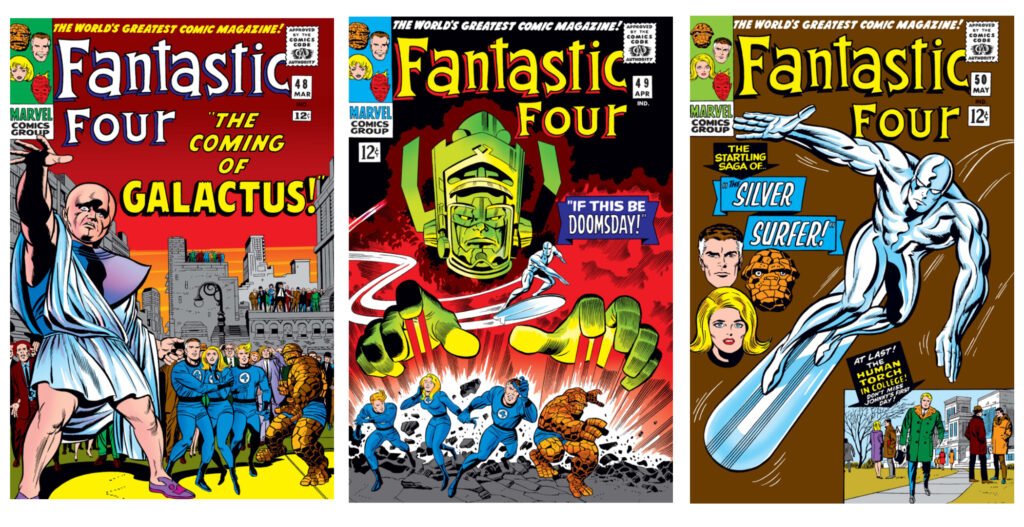
To understand Galactus's shifting scale, we must return to his genesis. He first descended upon Earth in 1968's Fantastic Four #48, kicking off the legendary "Galactus Trilogy" (Fantastic Four #48-50, March-May 1966). Visionaries Stan Lee and Jack Kirby didn't set out to create just another villain; they aimed for something grander. Kirby, drawing inspiration from biblical concepts, imagined Galactus as a "tremendous figure," a god-like cosmic entity. He wasn't evil in the conventional sense, but a force of nature, driven by an insatiable, existential hunger for the life force of living planets.
This initial conception was crucial. If Galactus was to be a god, a force beyond good and evil, he needed to look the part. Kirby’s design—a colossal figure in majestic, purple and blue armor—immediately conveyed immense power and ancient wisdom. His herald, the Silver Surfer, was conceived as a "fallen angel," further emphasizing the grand, quasi-religious scope of their arrival.
In these early appearances, Kirby rendered Galactus as undeniably enormous, yet not always planet-sized in every panel. He was drawn large enough to dwarf buildings, ships, and the Fantastic Four themselves, but the precise cosmic scale was often implied rather than overtly shown as consuming entire worlds. This early visual language established the flexibility that would define his character for decades.
The Silver Age Foundation: From Skyscraper to Stellar Scale
When Galactus first arrived, the visual spectacle was paramount. He wasn't just big; he was different. While he might have appeared initially smaller than an NYC skyscraper, the narrative quickly made it clear that his capabilities were far beyond Earthly comprehension. This initial ambiguity in exact size allowed for dramatic tension. The Fantastic Four could fight him, even if that fight was utterly futile against his true power.
As the "Galactus Trilogy" unfolded, the scope of his hunger became terrifyingly clear: he didn't just want to conquer, he wanted to consume. This required a scale beyond mere city-block destruction. The implication of his cosmic power expanded, and with it, the visual representation of his size. Artists began to depict him more frequently against cosmic backdrops, dwarfing moons and planets, his silhouette a testament to his unimaginable reach.
This period solidified the idea that Galactus’s size wasn’t merely static. It was a projection of his power, a direct manifestation of his cosmic energy and his ultimate purpose. When he arrived to devour a world, he was drawn large enough to make that threat feel imminent and overwhelming. When he needed to converse or exert a more focused influence, his scale could be modulated.
Bronze Age Expansion: New Heralds and Escalating Grandeur
The Bronze Age saw Galactus's mythos deepen considerably. New heralds, such as Gabriel the Air-Walker, Firelord, and Terrax, were introduced, each serving as a terrifying harbinger of his arrival. With each new herald came an expansion of Galactus's cosmic reach and, by extension, his implied size and power. These heralds weren't just powerful; they were mere extensions of a being so vast, so powerful, that he needed emissaries to scout out his next meal.
Storylines like "The Trial of Galactus" (Fantastic Four #242-244, #257-262, 1984) further cemented his place as a cosmic constant rather than a simple villain. In these narratives, his morality and necessity in the cosmic order were questioned, elevating him to a more complex, almost philosophical entity. Such existential debates implicitly required a being of immense, unchallengeable scale. You don't put a street-level thug on trial for the fate of the universe. He had to be enormous, not just physically, but symbolically.
Artists during this era continued to play with his scale, using grand, splash pages to convey his majesty and terror. He was often shown in space, his helmet peering over distant nebulae, or his hand cradling a planet like a child's toy. This era firmly established him as a character whose default scale was galactic, only diminishing when the narrative required him to interact on a smaller stage. For anyone Exploring Galactus immense size truly, the Bronze Age delivered on the promise of his cosmic majesty.
The Modern Era's Fluidity: Perception, Purpose, and Radical Rebirths
In the Modern Age of comics, the understanding of Galactus's fluctuating size became more explicitly defined as a deliberate power rather than just artistic license. Writers and artists leaned into the idea that Galactus can literally change his size and even his appearance at will.
This ability serves multiple narrative functions:
- Interaction: When he needs to communicate directly with characters like the Fantastic Four, he shrinks to a more manageable, albeit still towering, height. This allows for face-to-face dialogue and combat sequences that wouldn't be possible if he were constantly the size of Jupiter.
- Consumption: When he prepares to devour a planet, he often expands to truly gargantuan proportions, making the act visually terrifying and demonstrating the sheer scale of his hunger.
- Perception: A fascinating aspect of Galactus's lore is that his physical appearance adapts to the perception of different sentient viewers. To a human, he appears as a giant, armored humanoid. To a being from a silicon-based species, he might appear as an equally imposing, but silicon-based, entity. This explains why, even when "small," his form is always recognizable and uniquely terrifying to whomever observes him.
The 2010s introduced one of the most radical shifts in Galactus's identity and, consequently, his perceived scale. In Ultimates #2 (January 2016), he was temporarily transformed into the Lifebringer. No longer the Devourer of Worlds, he became a cosmic savior who revitalized dead worlds, pouring life back into barren planets. This transformation wasn't just a change in morality; it was a shift in visual language. As the Lifebringer, his colors often shifted to warmer, life-affirming hues, and his actions implied a nurturing, expansive presence rather than a destructive, consuming one. While still immense, his "size" felt less like an oppressive threat and more like a benevolent, life-giving force. This evolution didn't last forever, as cosmic balance demanded, and he reverted to his classic Devourer of Worlds role in Ultimates 2 #100 (August 2017). Yet, this period showcased the full potential for his character's dynamism, not just in purpose, but in how his very form could adapt.
Live-Action Adaptations: The Pitfalls and the Promise
Galactus's journey to live-action has been fraught with challenges, largely centered on how to translate his immense scale and unique design.
The Cloud Controversy: Fantastic Four: Rise of the Silver Surfer (2007)
His first live-action appearance in Fantastic Four: Rise of the Silver Surfer (2007) was, to put it mildly, controversial. Rather than his iconic humanoid form, Galactus was depicted as a voiceless, cosmic cloud or storm—a swirling mass of energy that consumed planets. This portrayal was widely criticized for deviating from his classic comic book appearance. The decision was likely a logistical one, attempting to convey an unimaginable scale without breaking the budget on a fully rendered, anthropomorphic planet-sized being. However, it stripped the character of his personality, his majesty, and his crucial ability to interact directly with other characters. He became an impersonal force, losing the "tremendous figure" quality Kirby had envisioned.
The MCU's Redemption: The Fantastic Four: First Steps (2025)
Fast forward to 2025, and the Marvel Cinematic Universe is set to correct past wrongs with The Fantastic Four: First Steps. The trailer's depiction of Galactus, voiced by Ralph Ineson, is a deliberate embrace of his classic humanoid design. More importantly, the variable size shown in the trailer is a brilliant, faithful nod to his comic book lore.
The MCU's approach understands that constantly depicting a planet-sized character would be:
- Logistically Impossible: Imagine trying to choreograph a fight scene or even a conversation with a character whose head is bigger than Earth.
- Narratively Limiting: It would prevent the crucial interactions, close-ups, and dramatic tension that come from characters sharing a space, even if one character vastly dominates it.
- Visually Monotonous: While awe-inspiring once or twice, a character perpetually depicted only as a distant cosmic entity would quickly lose its impact.
Instead, the MCU seems to be leveraging Galactus's inherent ability to change his size. He can be Manhattan-sized to interact with heroes or devastate a city, then grow to unimaginable proportions when he needs to absorb the energy of a world. This allows for both intimate terror and cosmic horror, making him a dynamic threat that can shift to fit the storytelling needs of any scene.
Understanding Galactus's Scale: It's More Than Just Mass
The true genius of Galactus's size isn't just that it fluctuates; it's why it fluctuates and what that communicates.
The Perception Principle
As mentioned, Galactus's form adapts to the observer. This isn't just a clever trick; it underscores his cosmic nature. He is so ancient, so fundamentally other, that his true form might be incomprehensible. The armored giant we see is merely the most accessible manifestation of his power, a bridge between his cosmic reality and our limited understanding. This means his "size" isn't a fixed measurement but a subjective experience.
The Narrative Utility
His shifting scale is a masterclass in narrative flexibility. A writer can have Galactus engage in a punch-up with the Avengers, then, in the very next panel, show him dwarfing an entire galaxy. This duality allows for both high-stakes, character-driven conflict and grand, cosmic spectacle. It means Galactus can be both a terrifying personal threat and an existential universal force, often simultaneously.
The Power Indicator
While not always strictly proportional, Galactus's size often scales with his cosmic energy reserves. When he's "starving" or weakened, he might appear smaller, his form less imposing. After a successful feeding, he could grow to truly unimaginable dimensions, radiating power. This visual cue helps convey his current state of being and the immediate threat he poses. It's a barometer of his cosmic might.
Common Misconceptions About Galactus's Size
Despite decades of comics, a few common misunderstandings persist about the Devourer's dimensions:
- "He's always planet-sized." This is perhaps the biggest misconception. While he can be, and often is depicted as such when consuming worlds, he frequently shrinks for personal interactions or combat. Many iconic covers and splash pages show him towering over skyscrapers or spacecraft, not entire planets.
- "His size is inconsistent writing." For casual readers, the variability might seem like a continuity error. However, as we've explored, this fluidity is a well-established and deliberate aspect of his powers, fundamental to his character and narrative function.
- "The MCU is shrinking him." The concern that the Fantastic Four: First Steps trailer shows a "shrunken" Galactus misses the point entirely. The MCU isn't reducing his power; it's accurately portraying his comic book ability to choose his scale. This allows for his iconic humanoid form to be present and interactive without the logistical impossibilities of a constant planet-sized entity.
The Art of Cosmic Scale: How Artists Convey Immensity
Drawing Galactus's size isn't just about making him big; it's about making him feel big, even when he's "smaller." Artists employ various techniques:
- Composition and Perspective: Using extreme angles, foreshortening, and placing smaller, familiar objects (like humans or buildings) in the foreground helps emphasize his overwhelming scale.
- Empty Space and Cosmic Backgrounds: Surrounding Galactus with vast expanses of starlight, nebulae, and distant galaxies immediately communicates his cosmic nature and immense size, even if no direct comparative object is in the panel.
- Lighting and Shadow: Dramatically lit, shadowed figures convey weight, presence, and power, making him feel physically substantial regardless of his precise dimensions.
- Facial Expressions (Even Through a Helmet): Despite the full helmet, artists expertly convey Galactus's emotions—hunger, stoicism, even occasional pity—through subtle angles and implied expressions, grounding his godlike stature with a touch of character.
Looking Ahead: What the MCU's Galactus Means for His Legacy
The MCU's decision to embrace the dynamic nature of Galactus's size is a significant moment for his legacy. It not only addresses the criticisms of past live-action attempts but also solidifies this crucial aspect of his character for a global audience. No longer will he be misunderstood as a mere cosmic cloud; he will be seen as the majestic, terrifying, and adaptable Devourer of Worlds, capable of both intimate confrontation and universe-shaking destruction.
This interpretation opens up vast storytelling possibilities, allowing the MCU to explore his complex morality, his unique relationship with his heralds, and the existential threat he poses, all while maintaining the visual fidelity fans have craved. His arrival will force humanity, and the heroes of Earth, to confront a being whose scale transcends their understanding, challenging their perceptions of power and survival.
Navigating the Cosmic Canvas: Appreciating Galactus's Dynamic Presence
The Evolution of Galactus's Size Across Comic Eras is not a tale of inconsistency, but one of deliberate, strategic design. It speaks volumes about the creative foresight of Lee and Kirby, and the ongoing ingenuity of the writers and artists who have continued to shape his mythos. Galactus is not just a character; he is a force, a cosmic constant whose very presence demands reverence.
So, the next time you see Galactus, whether in a comic panel or on the big screen, don't just marvel at his scale. Appreciate the nuance, the narrative purpose, and the artistic intent behind every fluctuating dimension. Understand that his fluid size isn't a limitation, but a testament to his unmatched power and his enduring status as one of Marvel's most iconic and compelling cosmic entities.