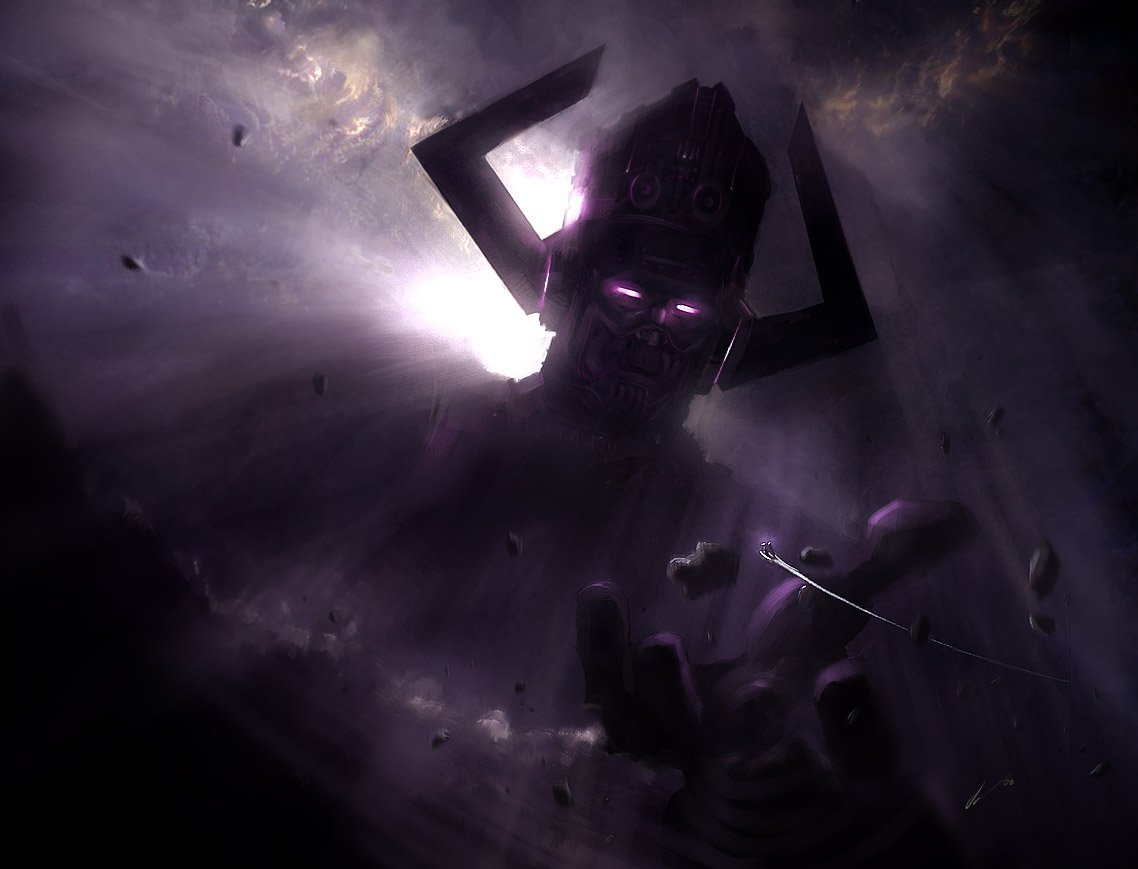
When the Devourer of Worlds, Galactus, made his highly anticipated MCU debut in The Fantastic Four: First Steps, audiences were immediately confronted with a staggering visual: a being so immense he could eclipse New York City. This visceral experience threw into sharp relief a core conundrum that has long fascinated fans and creators alike: the complex interplay between the truly observable, physical aspects of Galactus's size and the far more abstract, metaphysical dimensions of his scale. It's not just about how many feet or miles tall he stands, but what that immense presence represents in the vast tapestry of the cosmos.
Understanding Galactus means looking beyond mere measurements, delving into the very nature of his existence. Is he a giant, or something far more? Let's unpack the cosmic truth.
At a Glance: Galactus's Scale Unpacked
- Physical Fluctuations: Galactus's size is not fixed. While an "official" Marvel size exists (28 feet, 9 inches), he can change his physical manifestation at will, from human-like to planet-dwarfing.
- MCU Debut: In The Fantastic Four: First Steps, he appeared approximately 12 miles tall, shadowing NYC and towering over the Statue of Liberty.
- Beyond Earthly Scale: His power allows him to dwarf entire planets, making his full physical potential almost immeasurable.
- Metaphysical Presence: His "true" size is less about physical dimensions and more about his cosmic significance, energy signature, and role as a fundamental force of the universe.
- Perception is Key: The physical form we see is often a manifestation our mortal minds can comprehend, an avatar for an entity whose true nature transcends conventional space and time.
- Growth Through Consumption: His consumption of planets not only sustains him but can also enhance his cosmic power and, consequently, the scale of his physical manifestation.
The Physical Manifestation: A Shifting Giant in the MCU
Imagine a shadow falling over an entire metropolis, not from a cloud, but from a single, impossibly vast entity. That's the chilling spectacle Galactus presented in his MCU debut, voiced and motion-captured by Ralph Ineson. Looming over the iconic Statue of Liberty and casting a dark veil across most of New York City, this iteration of Galactus was estimated to be around 12 miles tall. This dramatic scale immediately captured the terror and awe that defines the character.
Yet, this isn't his only size. Marvel's official data for Galactus lists him at 28 feet, 9 inches. This seemingly contradictory figure highlights the core of his physical nature: he possesses the ability to change his size at will. He can manifest in a form that allows interaction with smaller beings, or he can expand to a scale capable of dwarfing entire planets. This isn't just a party trick; it's a fundamental aspect of his power and cosmic role. He must be able to shrink to confront individuals or grow to consume worlds, suggesting a dynamic, adaptable physical presence.
To truly grasp Galactus's physical immensity, it's helpful to place him in context with other large adversaries we've seen in the MCU. While 12 miles tall is monumental, he's not even the largest entity to grace Marvel's cinematic universe:
- Celestial Arishem (Eternals, 2021): The current record holder for sheer scale, Arishem reportedly towers twice Earth's height, roughly 16,000 miles from head to toe. Compared to Earth's 7,900-mile diameter, Arishem makes Galactus's NYC-looming form seem almost modest.
- Dormammu (Doctor Strange, 2016): The ruler of the Dark Dimension appeared miles tall, shrinking Doctor Strange to an almost invisible speck against his gargantuan form. Like Galactus, Dormammu's size is intrinsically linked to his dominion and power.
- Surtur (Thor: Ragnarok, 2017): Initially a mere 20 feet, Surtur achieved his full, terrifying form with the Eternal Flame, growing to approximately 1,000 feet—a literal tower over Asgard's palace. A formidable height, but still a fraction of Galactus's or Arishem's observed scale.
- Ego the Living Planet (Guardians of the Galaxy Vol. 2, 2017): Portrayed by Kurt Russell, Ego was a celestial being who was a planet. While impressive, he was explicitly stated to be "no bigger than your Earth's moon," making him about a quarter of Earth's size. His size is his entire being.
- The Elementals (Spider-Man: Far From Home, 2019): Mysterio's illusions conjured creatures that stood 300-400 feet tall, looking down on London's Tower Bridge.
- Sandman (Spider-Man: No Way Home, 2021): Flint Marko, in his largest sand form, could reach 150-200 feet, with his head alone towering 20 feet high.
These comparisons underscore that while Galactus is undeniably enormous, his physical size is not singular, nor is it necessarily the absolute largest we've seen. What sets him apart is the implication of his size – the ability to consume worlds, an act that transcends mere physical bulk. His appearance in Earth-828, a universe separate from the main MCU Earth-616, further hints at his multiversal adaptability and the potential for him to grow even larger by consuming more planets, a frightening prospect for future Phase 6 projects like The Fantastic Four starring Pedro Pascal, Vanessa Kirby, Joseph Quinn, and Ebon Moss-Bachrach.
But how can one being have such wildly varying physical dimensions? This is where the metaphysical aspect becomes not just relevant, but essential.
Beyond the Tangible: Unpacking Galactus's Metaphysical Form
To truly comprehend Galactus, we must venture beyond the realm of simple measurement and embrace the metaphysical. The term "metaphysical" here refers to aspects of his existence that transcend the purely physical, dealing with fundamental questions of being, reality, and consciousness. For Galactus, this means understanding that his "size" isn't merely a spatial dimension, but a conceptual one, tied to his cosmic power, role, and the very fabric of existence.
Think of it this way: your shadow doesn't define your true mass, but it certainly reflects your presence. Similarly, the physical form of Galactus is often described as merely a projection or an avatar that our limited mortal minds can perceive and process. His true form, it's often theorized in the comics, is beyond three-dimensional comprehension, an incomprehensible force of nature that can only be glimpsed in a form digestible by the observer. This means that to a human, he might appear as a colossal humanoid; to a cosmic entity, he might appear as a swirling vortex of energy, or perhaps something even more abstract. His physical size, then, is a relative construct, not an absolute.
This conceptual immensity is rooted in several key ideas:
Perception and Reality: The Incomprehensible Truth
The most foundational metaphysical aspect of Galactus's size is its reliance on perception. Different beings perceive him differently because his true cosmic form is so vast and complex that a singular, objective physical manifestation would shatter mortal sanity. What you see as a 12-mile tall giant over New York is merely how your brain translates the incomprehensible energy signature of Galactus into a recognizable, albeit terrifyingly enormous, shape. This isn't just an illusion; it's a fundamental filter through which reality is processed when encountering such a profound cosmic being. His physical form is a concession to our limitations, a visual placeholder for something far grander and more abstract.
The Embodiment of Cosmic Necessity: A Living Force of Nature
Galactus is not just a supervillain; he is often depicted as a fundamental force of the universe, a necessary catalyst for evolution and renewal. He is a cosmic abstract, much like Death or Eternity, given a corporeal form. His "size" in this context is less about linear feet and more about his universal impact. His scale reflects the scale of his purpose: to prune older, stagnant worlds to allow new ones to flourish, a brutal but essential cycle in the cosmic order. His presence isn't confined to a single point in space; it resonates across the cosmos, a looming shadow of ultimate fate. To truly appreciate his impact, consider Understanding Galactus's true scale beyond just what meets the eye.
Hunger as an Expansive Force: Growth Beyond Consumption
His insatiable hunger is more than just a biological imperative; it's a driver of his metaphysical expansion. When Galactus consumes a planet, he's not just absorbing matter; he's absorbing cosmic energy, life force, and the potential of a world. This consumption doesn't just sustain his existing form; it amplifies his power, expands his cosmic energy signature, and, consequently, broadens the scope of his metaphysical presence. His growth isn't a simple caloric intake; it's an increase in his cosmic footprint, a deepening of his fundamental connection to the universe. The more he devours, the more potent and encompassing his essence becomes, making his perceived physical manifestation potentially larger and more potent.
Existence Across Dimensions: The Multiversal Being
Galactus exists across various realities and dimensions. His very being is multi-faceted, not confined to a single three-dimensional space. This means that his "size" could be an effect that ripples across these planes, influencing realities in ways that aren't physically measurable within a single universe. His true form might be more akin to a nexus of cosmic energy stretching across the multiverse, with his physical manifestation in any given reality being just a fragment or a localized projection of that grander, multi-dimensional self. When we speak of his size, we are often only talking about his manifestation within our specific corner of reality, ignoring the true scope of his cross-dimensional existence.
The Interplay: Where Physical Meets Metaphysical
The true brilliance of Galactus's character lies in the seamless, terrifying interplay between his physical and metaphysical aspects. They are not separate but two sides of the same cosmic coin. His physical size, whether it's 28 feet or 12 miles or planet-dwarfing, is a direct, visible consequence of his underlying metaphysical power and cosmic role.
Consider the perceived contradiction: an "official" size of 28 feet, 9 inches versus an on-screen appearance of 12 miles tall, capable of dwarfing planets. The metaphysical explanation resolves this apparent paradox. The 28-foot size could be seen as his "default" or "minimum" manifestation when dealing with specific, smaller entities or needing to navigate constrained environments. It's a pragmatic reduction of his cosmic essence into a form that can interact without immediately annihilating everything around him.
Conversely, his 12-mile tall form over NYC, or his ability to dwarf planets, represents an expanded projection of his power and intent. When he is actively devouring or asserting his cosmic will, his physical form scales up to appropriately reflect that immense power and purpose. It's not that he's "actually" 28 feet and just growing; it's that his true, immeasurable self manifests at a scale appropriate to the situation and the observers. The bigger his cosmic ambition (to devour a world), the larger the physical avatar he projects.
This duality enhances his character, making him both a tangible threat that can be physically confronted (at least in principle) and an existential dread that transcends mere punching. He is a monster of impossible scale, but also a force that represents the fundamental, often brutal, mechanics of the universe. This makes him far more compelling than a simple giant. It means his threat isn't just about his destructive power, but about the very concept of cosmic inevitability he embodies.
MCU's Galactus: A Glimpse into the Immeasurable
The MCU's initial portrayal of Galactus in The Fantastic Four: First Steps is a masterclass in establishing this dual nature. While we see a physical, identifiable form shadowing a familiar cityscape, the sheer scale immediately suggests something beyond ordinary understanding. His ability to loom over the Statue of Liberty and cast shadows across New York implies a presence that defies conventional physics, hinting at the metaphysical underpinnings.
His arrival in the deep end of the universe containing Earth-828 is more than just a plot device; it's a subtle nod to his multiversal existence and his capacity to traverse vast cosmic distances. The suggestion that he could grow "even larger by consuming more planets" doesn't just mean a physical expansion; it implies a corresponding increase in his cosmic energy, his metaphysical might, and thus the potential for even grander, more terrifying physical manifestations in subsequent MCU projects.
The MCU, by introducing him in this way, balances the need for a cinematic, visually impactful villain with the rich, often philosophical, lore of his comic book origins. It sets the stage for a character who is both a concrete threat that the Fantastic Four must face and an abstract concept that challenges their understanding of the universe itself. The creative team understands that the fear of Galactus isn't just about his size; it's about the very idea of a force so powerful that it casually erases worlds from existence, a force whose scale, both physical and metaphysical, is almost impossible to comprehend.
Common Questions and Cosmic Conundrums
The unique nature of Galactus's size naturally leads to a host of questions. Let's tackle some of the most frequently asked, drawing on both his physical manifestations and his metaphysical reality.
Is his "true" size fixed, or does it constantly change?
His physical manifestation changes at will, adapting to his needs and his environment. However, his "true" form, the metaphysical entity beyond mortal comprehension, is not a fixed, measurable size in the conventional sense. It's a dynamic, cosmic energy signature that expands or contracts in influence and power, much like a force field rather than a rigid structure. So, while his perceived physical size fluctuates wildly, his underlying cosmic essence is a constant, though evolving, presence.
How can he fit on a screen if he's planet-sized?
This is precisely where the concept of perception and projection comes into play. What we see on screen, or what a character within the story sees, is not necessarily Galactus's entire being or his absolute largest form. It's a contextual manifestation—a fragment or an avatar scaled down (or up) to be visible and comprehensible within the frame of the story and the limits of our perception. Even when he appears to dwarf a planet, that's still a manifestation designed to convey his power, not necessarily his entire immeasurable reality.
Why does his size fluctuate so much in different depictions?
The fluctuation is integral to his character. It allows creators to tailor his appearance to the narrative needs. A smaller, human-scale Galactus might appear in a more personal confrontation, while a planet-sized one is reserved for world-ending threats. This adaptability in his physical form is a visual shorthand for his immense, shapeless cosmic power, making him a more versatile and terrifying antagonist. It reinforces the idea that his form is merely a vessel for his cosmic will.
Is he the biggest entity in the Marvel Multiverse?
While Galactus is undeniably enormous and can dwarf planets, he is not the largest in terms of raw physical scale within the MCU or the broader Marvel Multiverse. As discussed, the Celestial Arishem, at an estimated 16,000 miles tall, holds the current record for sheer physical bulk in the MCU. In the comics, there are other entities, like some Celestials or cosmic abstracts in their full forms, that might physically surpass him. However, Galactus's "size" is less about being the absolute biggest and more about his unparalleled destructive capacity and his unique role as a cosmic constant. His scale is significant because it allows him to fulfill his role as the Devourer, a role that few, if any, can replicate.
Embracing the Scale: A New Perspective on the Devourer
Galactus is more than just a giant space monster; he is a profound statement on scale, power, and the nature of reality itself. His dual existence, encompassing both the measurable physical and the incomprehensible metaphysical, elevates him beyond a simple villain. He is a cosmic phenomenon, a being whose "size" is as much about his role and impact on the universe as it is about his height or breadth.
The next time you witness Galactus on screen or read about his devastating presence in the comics, remember to look beyond the immediate visual. Consider the silent horror of his true, abstract scale – a being whose existence transcends our understanding of space and form, whose hunger is a force of nature, and whose physical manifestation is merely a window into a truly immeasurable cosmic truth. His size, in all its forms, is a testament to the boundless imagination of the Marvel universe and a constant reminder that some forces are simply too grand to be confined by mere numbers.